2.2 Scaling GPU Infrastructure
What the exam tests
Scale-up vs scale-out strategies, NVLink, NVSwitch, and how NVIDIA’s multi-GPU interconnect technology enables linear performance scaling.
Scale-Up vs Scale-Out
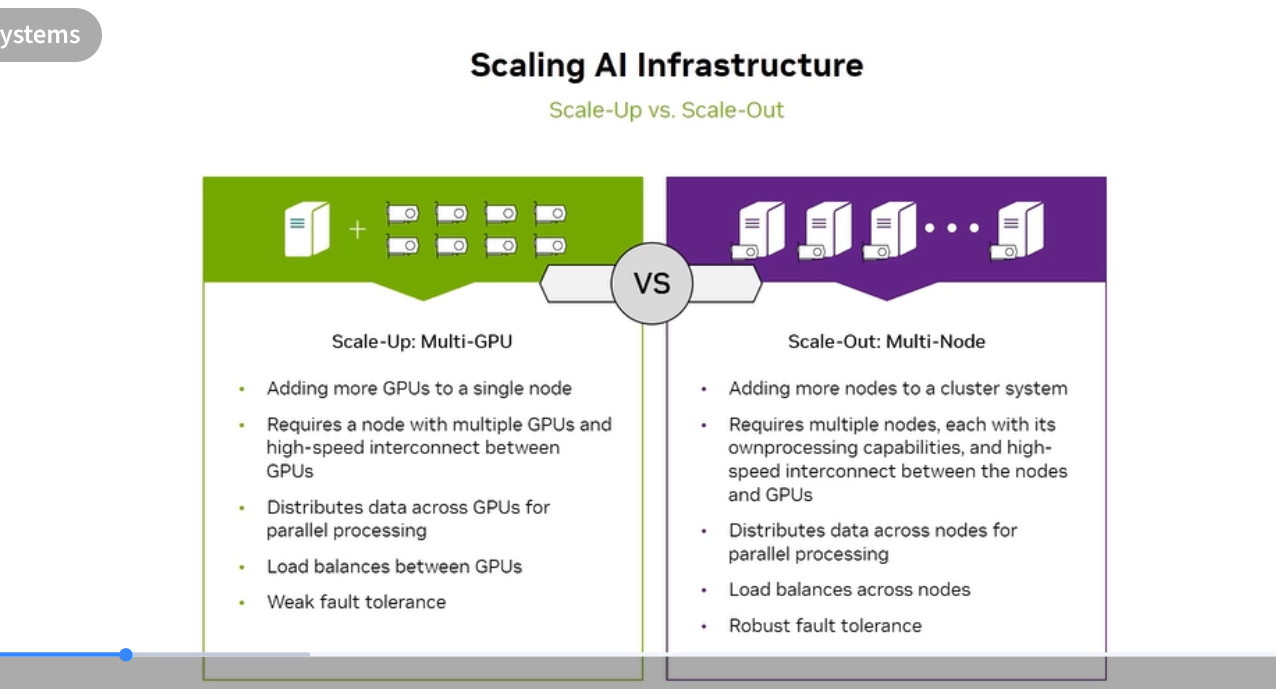
| Scale-Up (Multi-GPU) | Scale-Out (Multi-Node) | |
|---|---|---|
| Definition | Add more GPUs to a single server | Add more servers to a cluster |
| Interconnect | NVLink / NVSwitch (within server) | InfiniBand / Ethernet (between servers) |
| Communication | Very high bandwidth (900 GB/s – 1.8 TB/s) | Lower bandwidth (400 – 800 Gbps) |
| Latency | Sub-microsecond | Microseconds |
| Load balancing | Between GPUs in node | Between nodes |
| Fault tolerance | Weak — single server failure loses all GPUs | Robust — one node failure affects only part of cluster |
| Use case | Models that fit within one node; latency-sensitive | Models too large for one node; maximum scale |
Exam tip: These are not mutually exclusive — production AI clusters use both: scale-up within each DGX node, scale-out across nodes via InfiniBand.
Multi-GPU Systems: the PCIe bottleneck
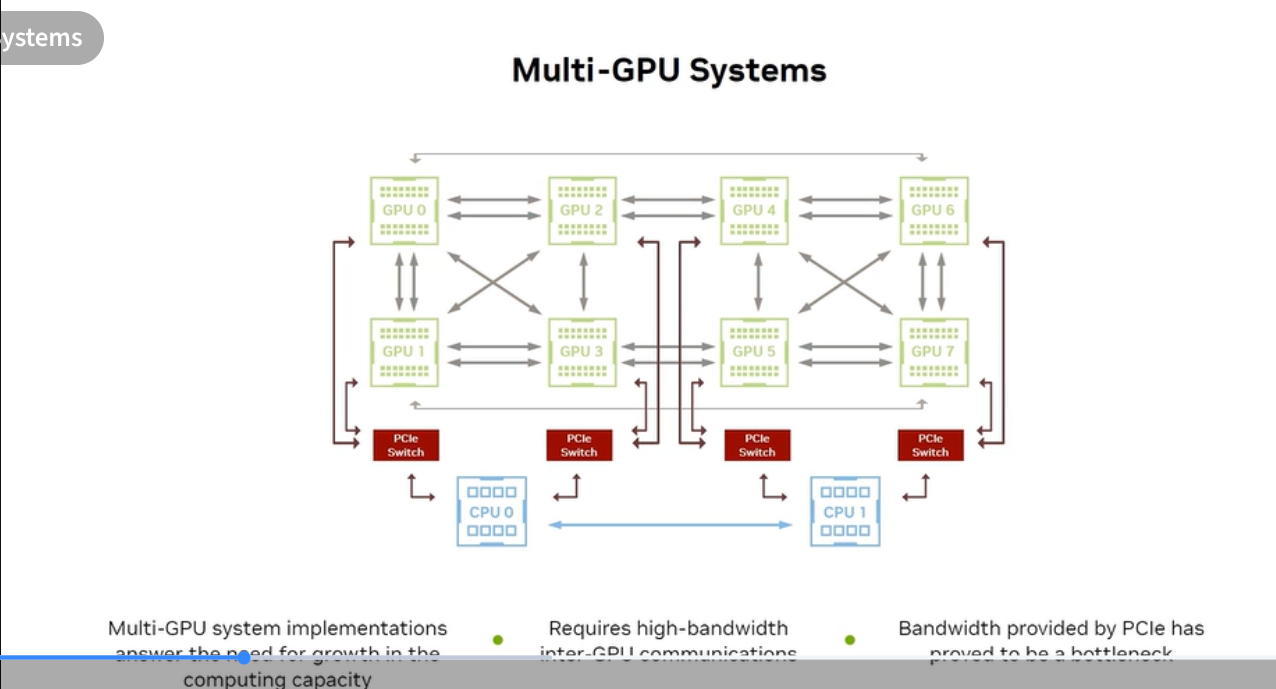
Early multi-GPU systems used PCIe switches to connect GPUs. The problem:
- PCIe Gen4 x16 provides ~64 GB/s bidirectional bandwidth
- Neural network layers exchange large activation tensors between GPUs
- PCIe bandwidth became the bottleneck — GPUs spent more time waiting for data than computing
- Multi-GPU system implementations require high-bandwidth inter-GPU communications
This is why NVIDIA developed NVLink — to eliminate the PCIe interconnect bottleneck for GPU-to-GPU communication.
NVLink: GPU-to-GPU Communication
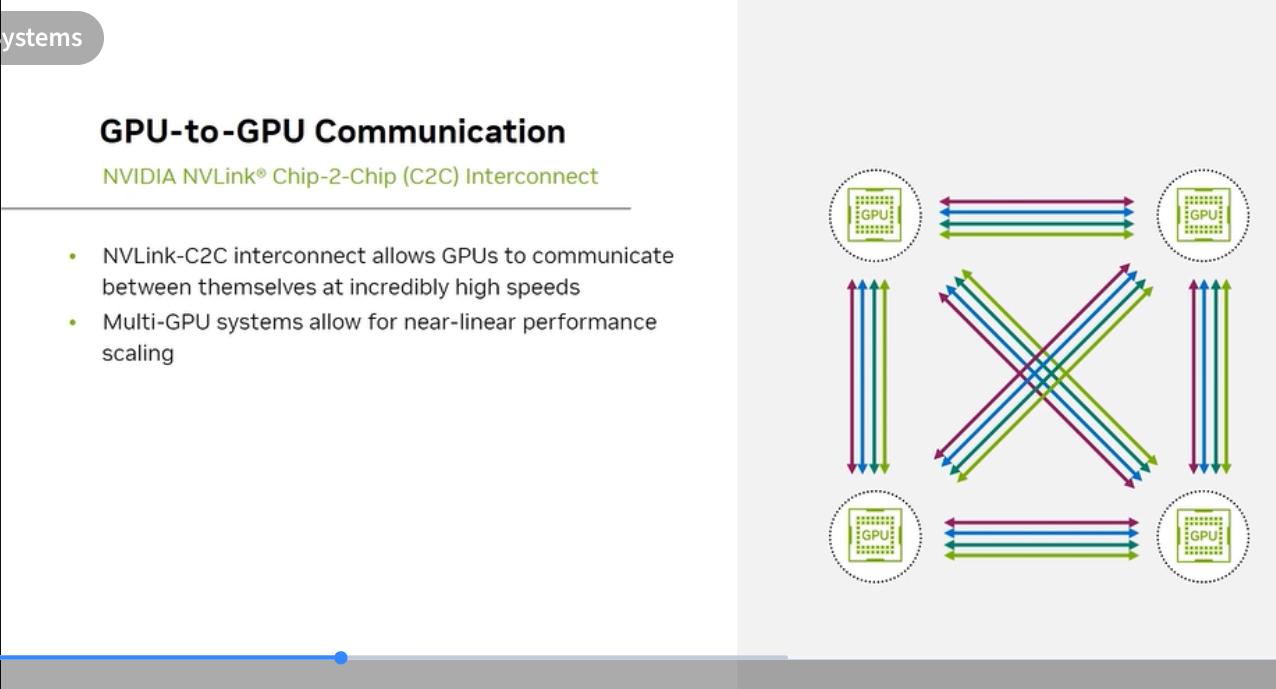
NVLink is NVIDIA’s proprietary high-speed GPU interconnect. It replaces PCIe for GPU-to-GPU transfers.
- NVLink-C2C (Chip-to-Chip): Direct die-to-die connection, used inside Superchips (Grace↔GPU)
- NVLink 4 (Hopper): 900 GB/s total bidirectional bandwidth per GPU
- NVLink 5 (Blackwell): 1.8 TB/s total bidirectional bandwidth per GPU
- Coherent memory: Applications see GPU and CPU memory as a unified address space (in Superchip configurations)
- Near-linear performance scaling: Adding GPUs connected via NVLink scales performance almost linearly because bandwidth isn’t the bottleneck
NVLink generations
| Generation | GPU | Total BW per GPU | Key feature |
|---|---|---|---|
| NVLink 2 | V100 | 300 GB/s | First mainstream NVLink |
| NVLink 3 | A100 | 600 GB/s | SXM4 package |
| NVLink 4 | H100 | 900 GB/s | C2C for GH200 |
| NVLink 5 | B200 | 1.8 TB/s | 5th gen in GB300 NVL72 |
NVSwitch: All-to-All GPU Communication
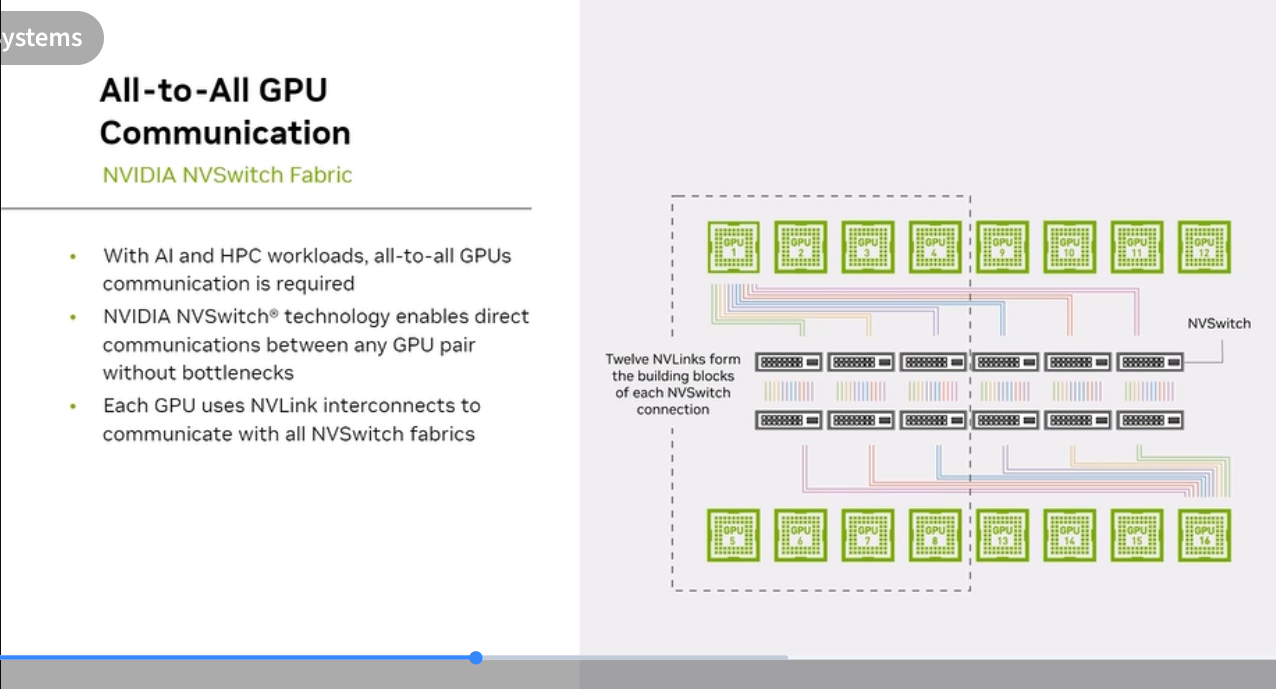
NVSwitch is a dedicated silicon switch that creates a fully non-blocking, all-to-all NVLink fabric across all GPUs in a system.
- Without NVSwitch: GPUs connect peer-to-peer via limited NVLink ports — not all pairs can communicate simultaneously
- With NVSwitch: Any GPU can communicate with any other GPU at full bandwidth simultaneously — true all-to-all
- DGX H100 uses 4× NVSwitch chips to create the 8-GPU all-to-all fabric
- Each GPU uses its NVLink ports to connect to the NVSwitch, which routes traffic between GPUs
Why all-to-all matters for AI
AI/HPC workloads require collective operations: all-reduce (gradient sync), all-gather (parameter distribution), reduce-scatter. These operations require every GPU to exchange data with every other GPU simultaneously. NVSwitch enables this at full NVLink bandwidth — no congestion, no bottlenecks.
              NVSwitch (x4 in DGX H100)
                  /  |  |  |  \
    GPU0 --- GPU1 --- GPU2 --- GPU3
     |               |               |
    GPU4 --- GPU5 --- GPU6 --- GPU7

    Each GPU: full NVLink bandwidth to ALL other GPUs simultaneously
DGX H100: Scale-Up in Practice
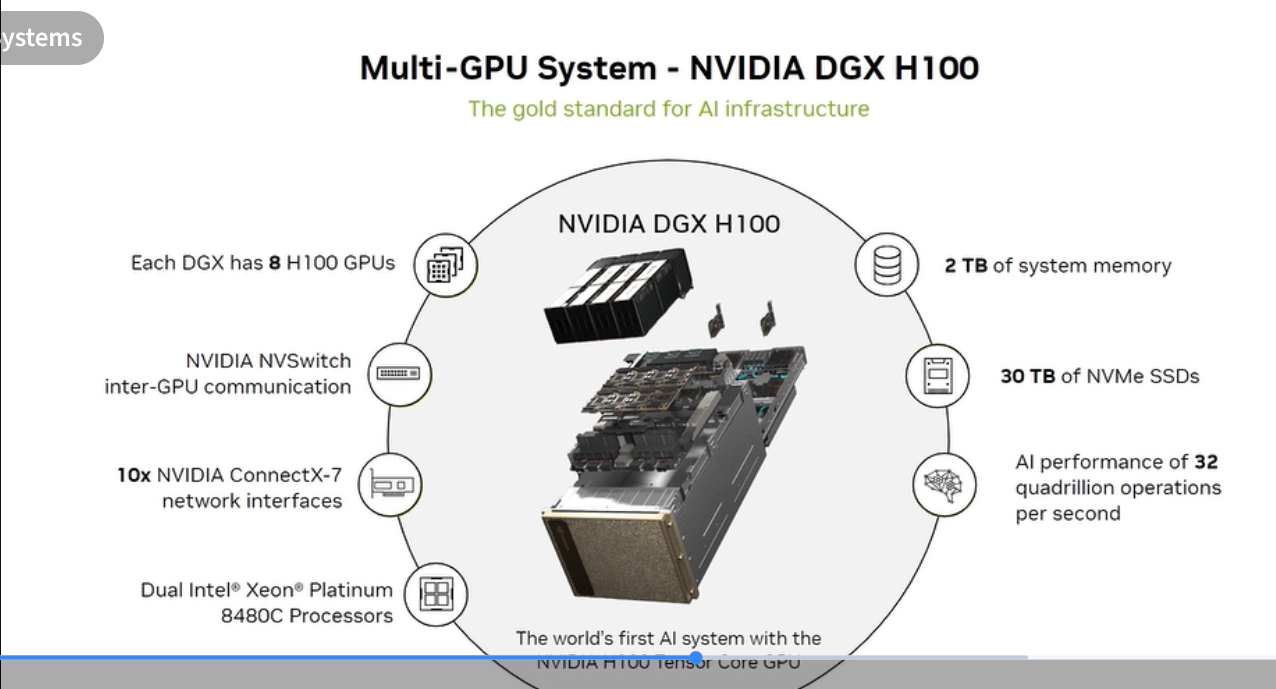
The DGX H100 is NVIDIA’s reference AI training system. Key specs:
- 8× H100 SXM5 80GB Tensor Core GPUs
- 4× NVSwitch for 900 GB/s all-to-all GPU interconnect
- 2 TB system memory
- 30 TB NVMe SSDs (local, high-speed model checkpointing)
- 8× ConnectX-7 400Gbps InfiniBand NICs (scale-out to other DGX nodes)
- 2× Intel Xeon Platinum 8480C CPUs
- AI performance: 32 quadrillion operations per second
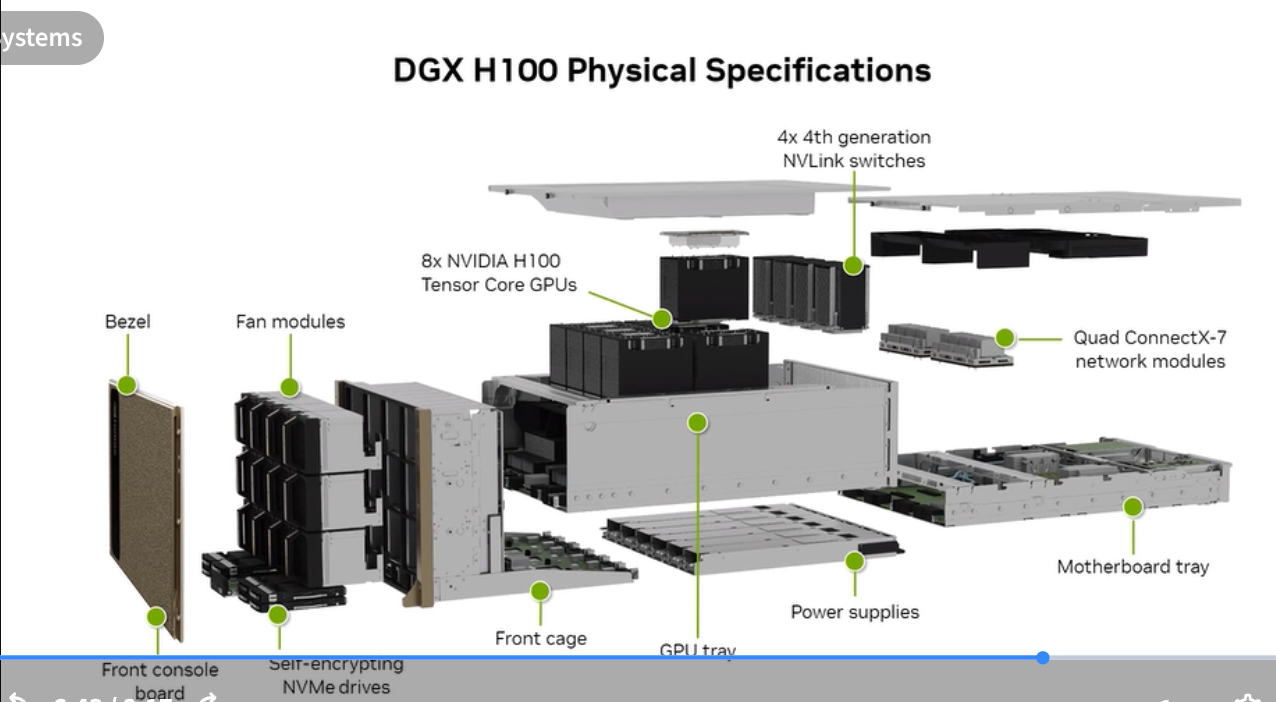
Physical design: 10U rack server with dedicated front-panel, fan modules, NVLink switches, power supplies, and ConnectX-7 network modules.
Self-check questions
- What is the main trade-off between scale-up and scale-out?
- Why did PCIe become a bottleneck for multi-GPU systems before NVLink?
- How much total NVLink bandwidth does each H100 GPU have?
- What problem does NVSwitch solve that simple NVLink peer-to-peer connections cannot?
- How many NVSwitch chips does the DGX H100 contain?
Answers
1. Scale-up: very high bandwidth (NVLink), sub-microsecond latency, but limited by server size and weak fault tolerance. Scale-out: robust fault tolerance, near-infinite scale, but lower inter-node bandwidth and higher latency.2. PCIe bandwidth (~64 GB/s per slot) is far lower than the data exchange rates needed between GPUs for neural network operations. GPUs stalled waiting for data, preventing efficient parallel compute.
3. 900 GB/s bidirectional (NVLink 4, Hopper) — Blackwell (NVLink 5) increases this to 1.8 TB/s.
4. NVSwitch enables any-to-any full-bandwidth communication simultaneously. Without it, a GPU can only connect to its directly linked peers via NVLink. NVSwitch creates a non-blocking crossbar so all 8 GPUs in a DGX can exchange data with all others at the same time without contention.
5. 4× NVSwitch chips.