1.6 NVIDIA Solutions: Purpose and Use Cases
What the exam tests
Which GPU/system/software is the right fit for a given workload. The exam frequently presents a scenario and asks which NVIDIA product family addresses it.
GPU families and their workloads
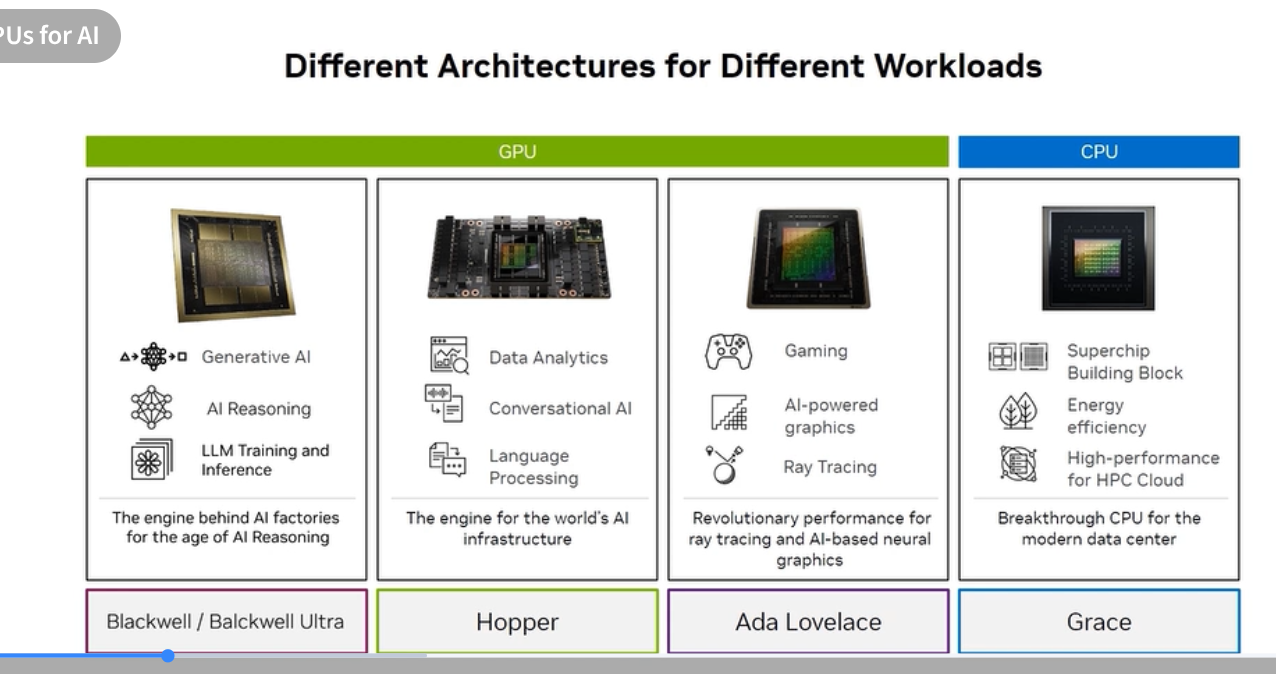
Blackwell / Blackwell Ultra (B200, B300)
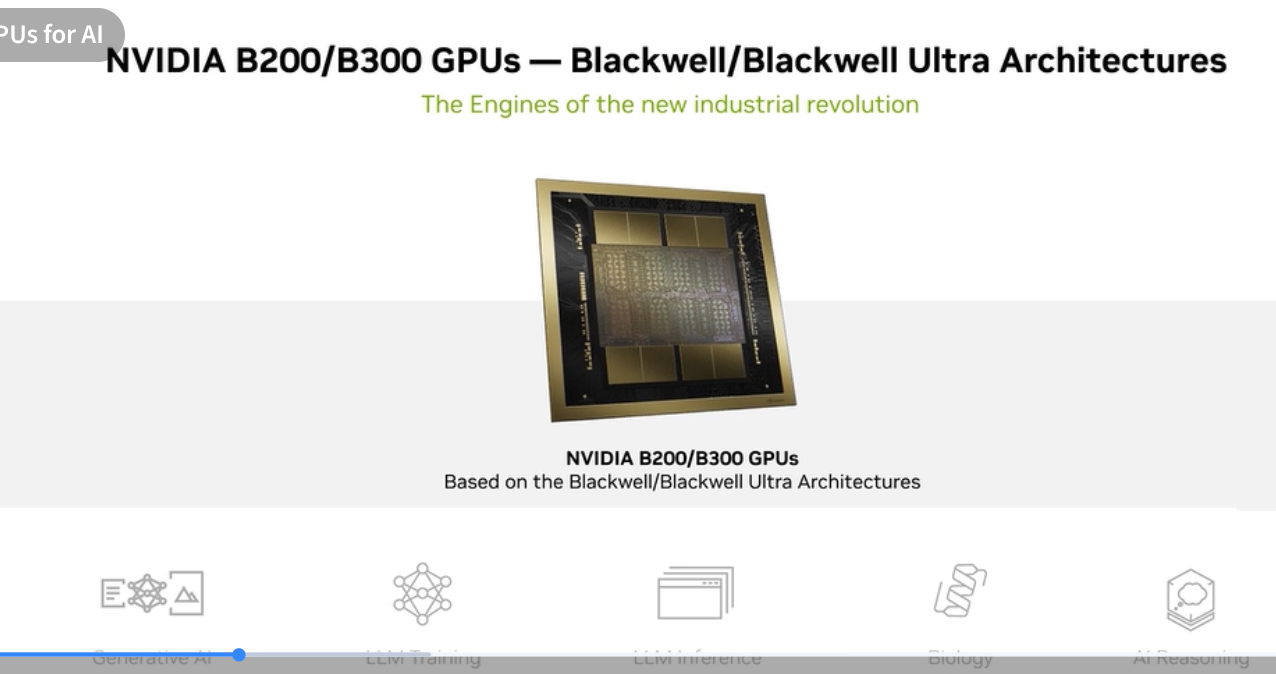
- Primary use: Generative AI, AI reasoning, LLM training, LLM inference, Biology/AI drug discovery
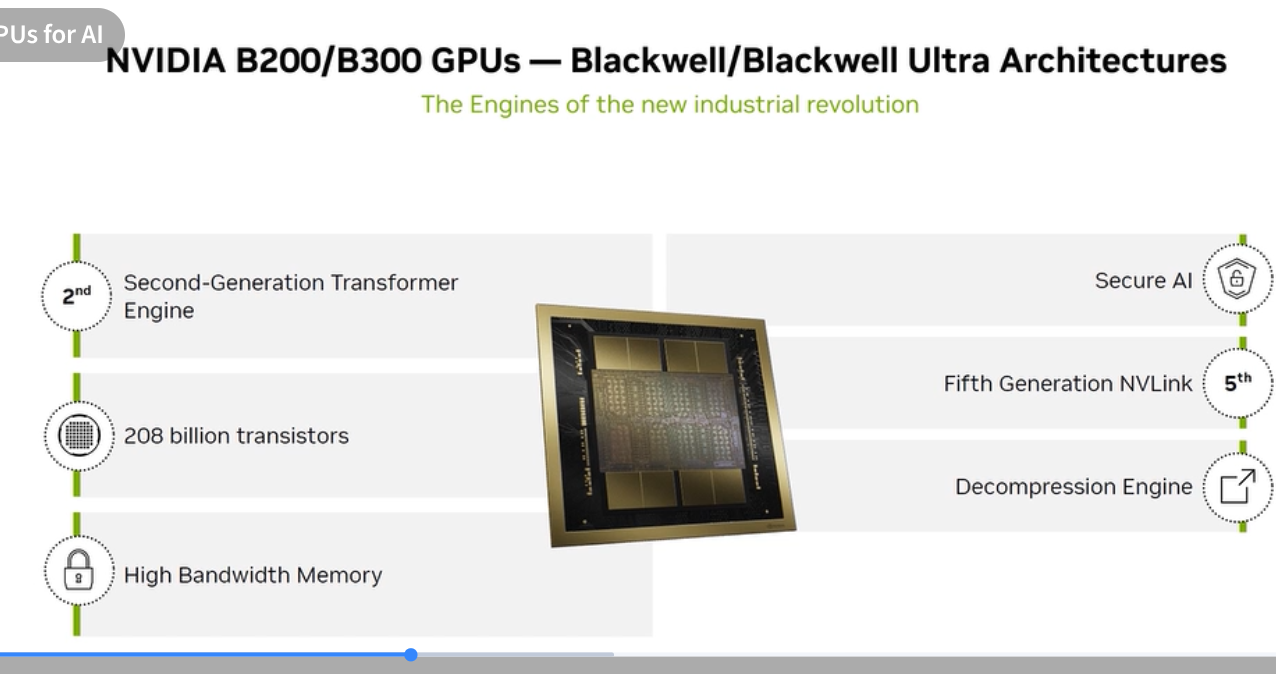
- Architecture highlights:
- 208 billion transistors
- 2nd-generation Transformer Engine (FP4/FP8/FP16/BF16)
- 5th-generation NVLink (1.8 TB/s bidirectional per GPU)
- HBM3e high bandwidth memory
- Secure AI enclave
- Hardware decompression engine
Key message: B200/B300 is “the engine of the new industrial revolution” — NVIDIA’s positioning for the biggest generative AI training and inference jobs.
Hopper (H100, H200)
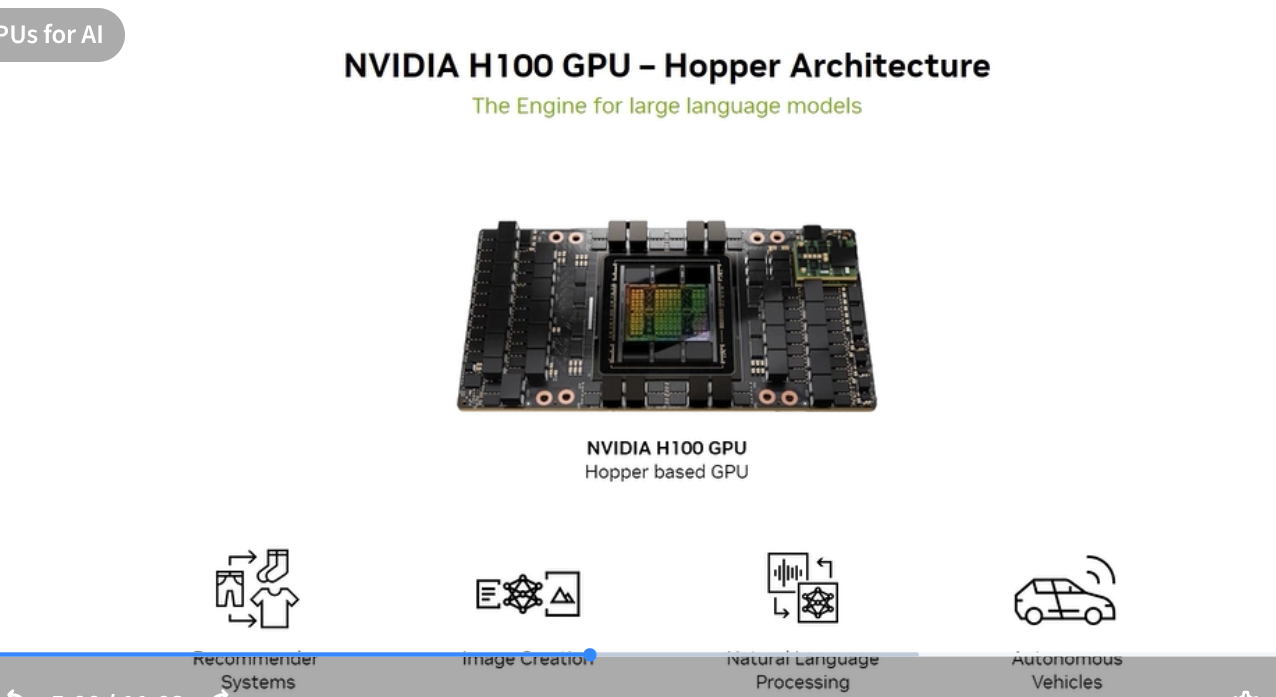
- Primary use: Large language models, data analytics, conversational AI, image creation, natural language processing, autonomous vehicles
- Key specs (H100 SXM5):
- 80 GB HBM3 (H100) / 141 GB HBM3e (H200)
- 3.35 TB/s memory bandwidth (H100) / 4.8 TB/s (H200)
- 4th-gen Tensor Cores with FP8 support
- 4th-gen NVLink (900 GB/s)
- Transformer Engine (auto-switches FP8/FP16 per layer)
- Confidential Computing support
Ada Lovelace (L40S, L40, L4)
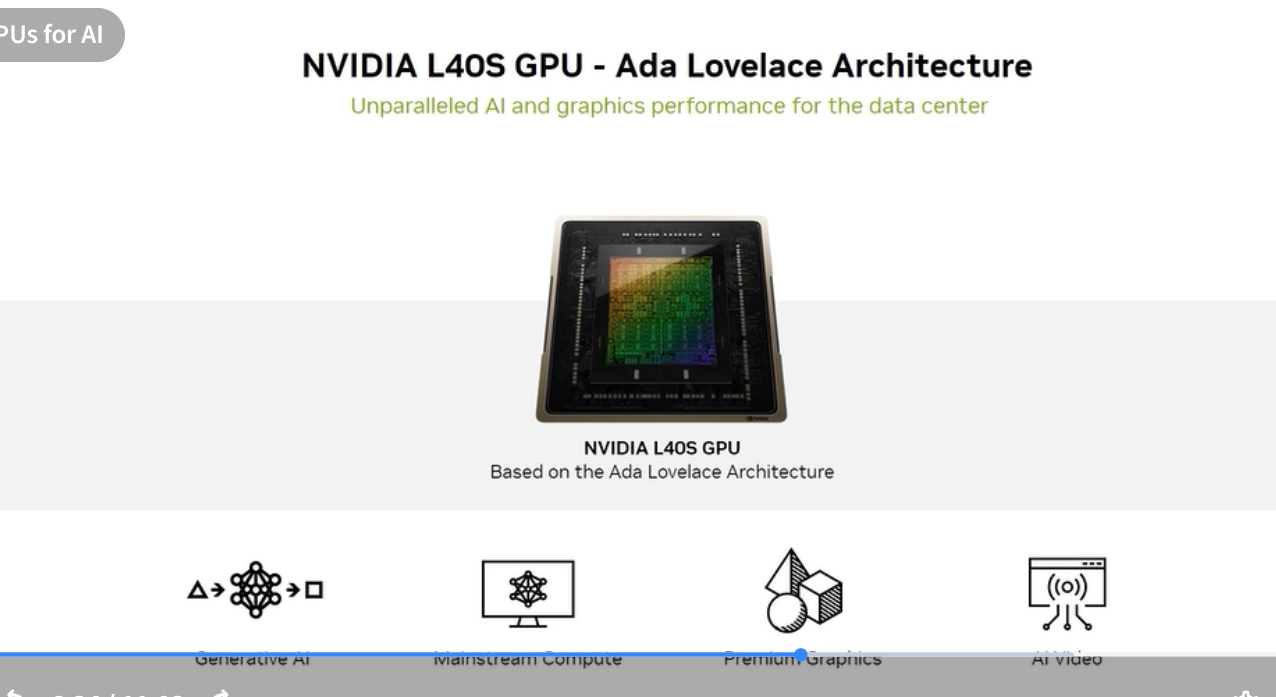
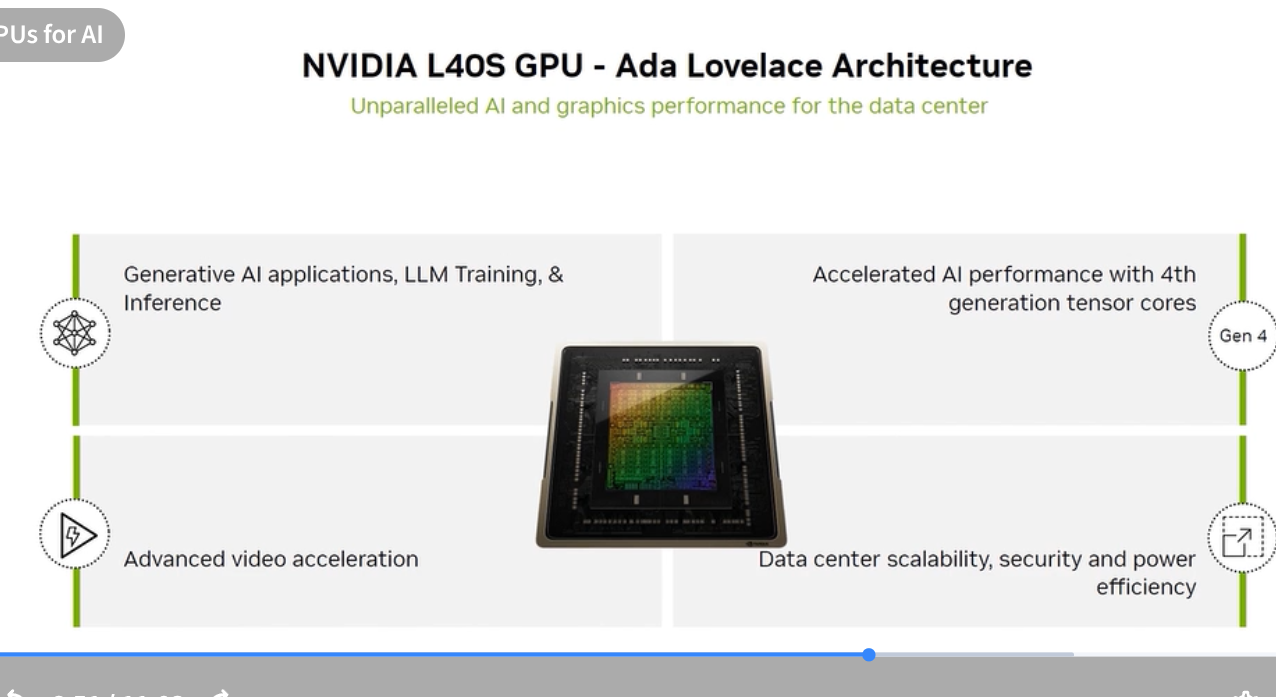
- Primary use: Generative AI inference + graphics in one GPU; AI video, premium visualization, mainstream data center compute, VDI/VPC
- Key specs (L40S):
- 48 GB GDDR6 (not HBM — lower bandwidth but sufficient for inference + compute)
- 4th-gen Tensor Cores, 5th-gen RT Cores
- Advanced video acceleration (AV1 encode/decode)
- Data center scalability, security, power efficiency
Differentiator vs Hopper: L40S is the do-it-all card — handles both AI inference and rendering workloads on a single GPU. H100 is purely for compute.
Grace CPU
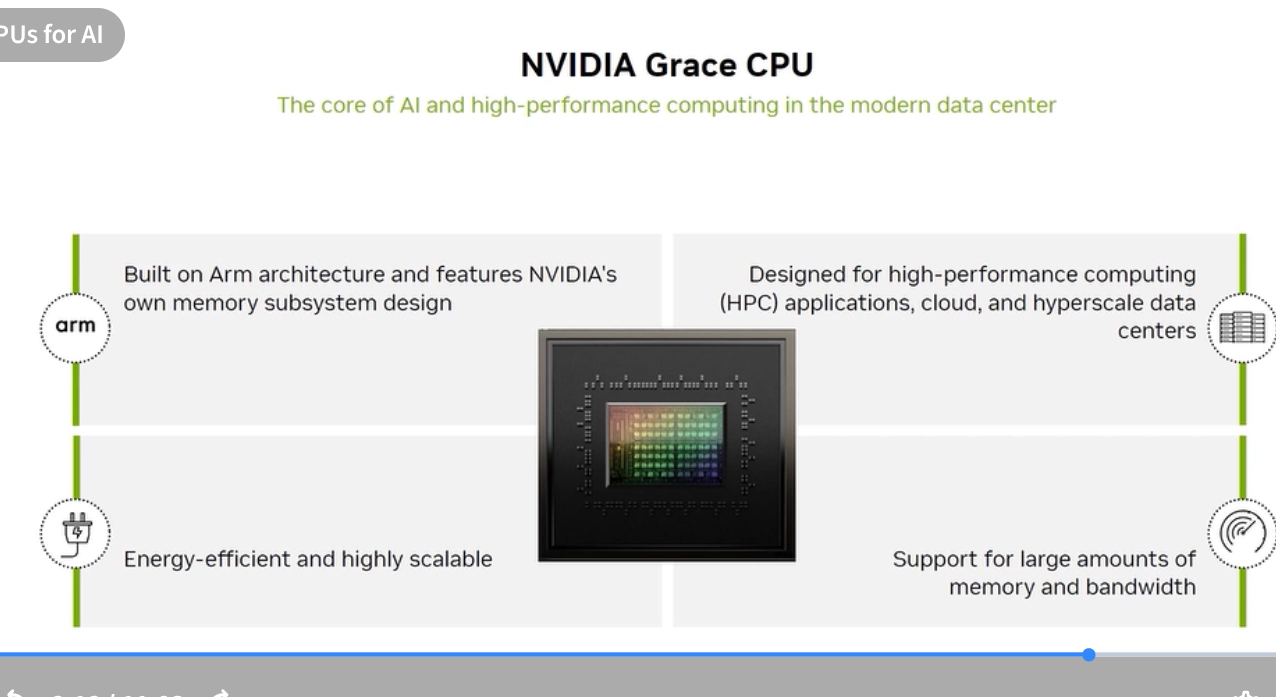
- Primary use: HPC, cloud computing, hyperscale data centers
- Architecture:
- Arm-based (72 Arm Neoverse V2 cores)
- NVIDIA proprietary memory subsystem
- Highly scalable and energy efficient
- Supports large amounts of memory and bandwidth (LPDDR5X)
- Role: Building block for Grace Superchips (GH200, GB200); enables tight CPU↔GPU integration via NVLink-C2C
Data center GPU use-case matrix
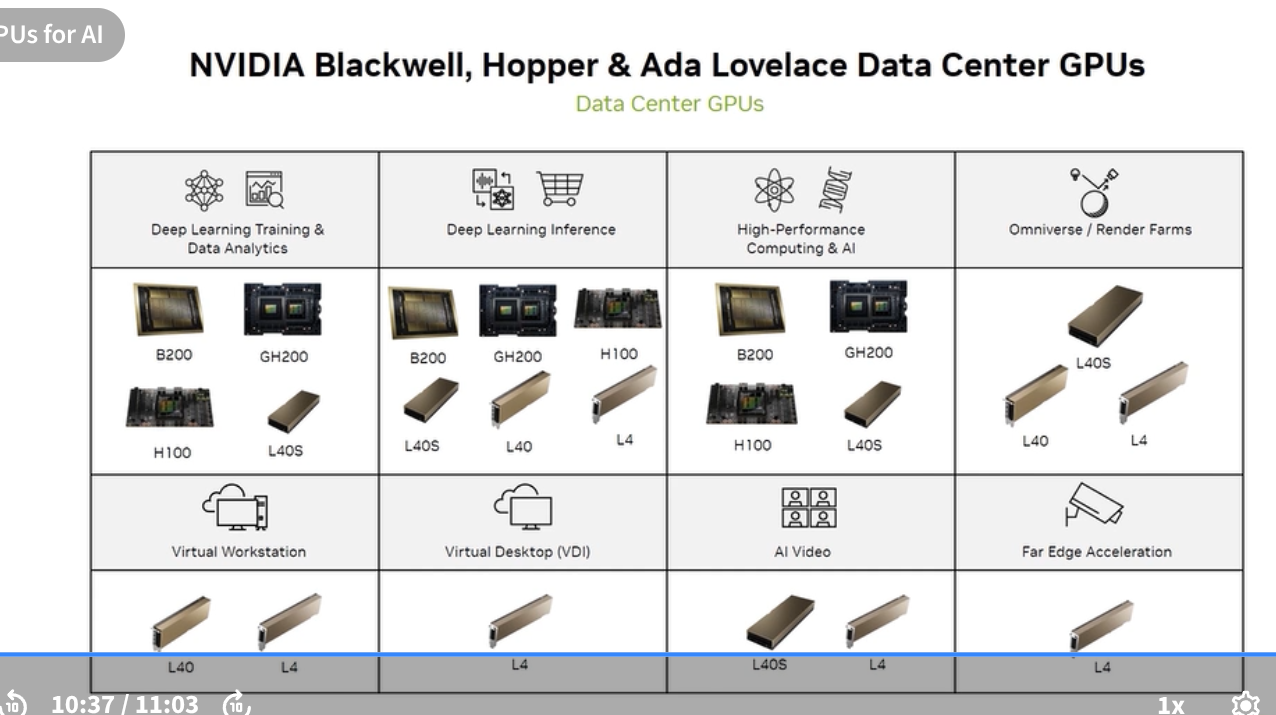
This matrix shows which GPUs NVIDIA recommends per workload:
| Workload | Recommended GPUs |
|---|---|
| Deep Learning Training & Data Analytics | B200, GH200, H100, L40S |
| Deep Learning Inference | B200, GH200, H100, L40S, L40, L4 |
| HPC & Scientific Computing & AI | B200, GH200, H100, L40S |
| Omniverse / Render Farms | L40S |
| Virtual Workstation | L40 |
| Virtual Desktop (VDI) | L4 |
| AI Video | L40S, L4 |
| Far Edge Acceleration | L4 |
RTX PRO Server
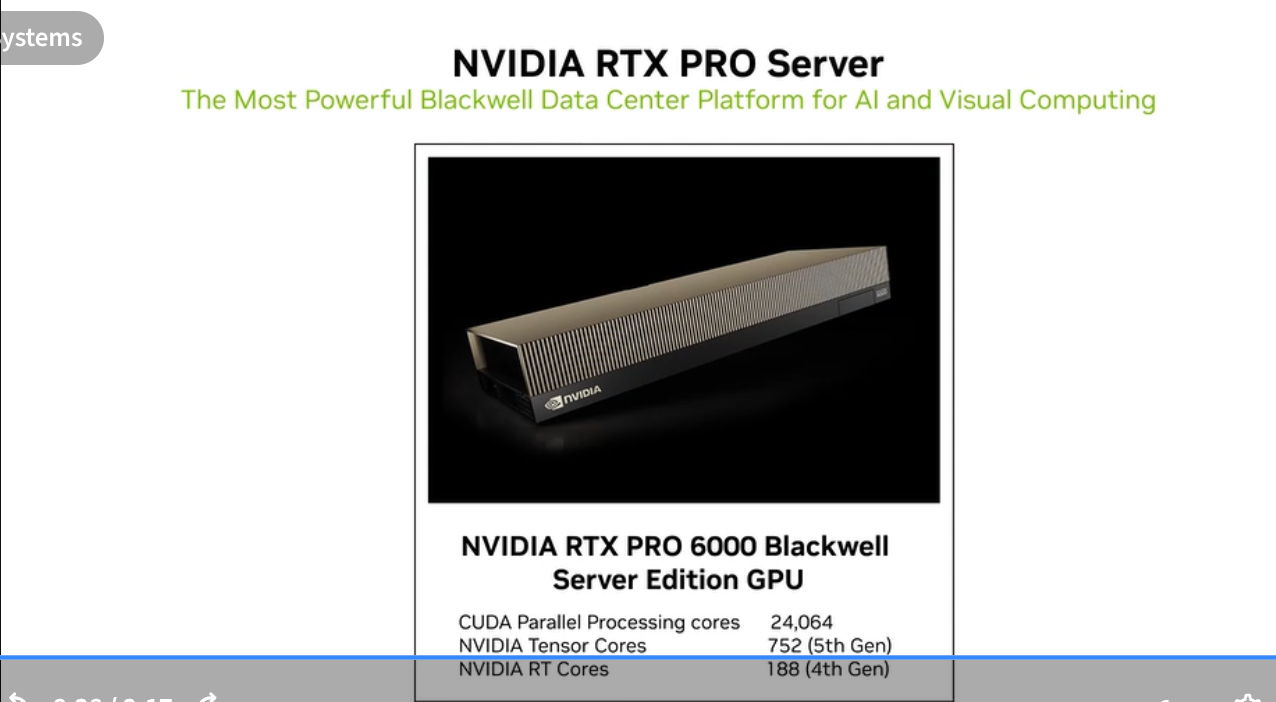
- Product: NVIDIA RTX PRO 6000 Blackwell Server Edition GPU
- Purpose: Most powerful Blackwell data center platform for AI and visual computing
- Key specs:
- 24,064 CUDA parallel processing cores
- 752 5th-gen Tensor Cores
- 188 4th-gen RT Cores
Targets workloads that need both AI acceleration and photorealistic rendering in a data center environment (e.g., engineering simulation, digital twin).
Self-check questions
- Which GPU family is described as “the engine of the new industrial revolution” for generative AI?
- An enterprise needs a single GPU for LLM inference AND professional visualization. Which family fits?
- What unique feature does the Blackwell architecture add compared to Hopper’s Transformer Engine?
- Which NVIDIA GPU is recommended for VDI (Virtual Desktop Infrastructure)?
- How many transistors does the B200 GPU contain?
Answers
1. Blackwell / Blackwell Ultra (B200, B300)2. Ada Lovelace (L40S)
3. Second-generation Transformer Engine with FP4 support (Hopper had first-gen, supporting FP8)
4. L4 (for VDI); L40 for Virtual Workstation
5. 208 billion transistors